
Milestone
USERN Presidential Election, from 2026 to 2028
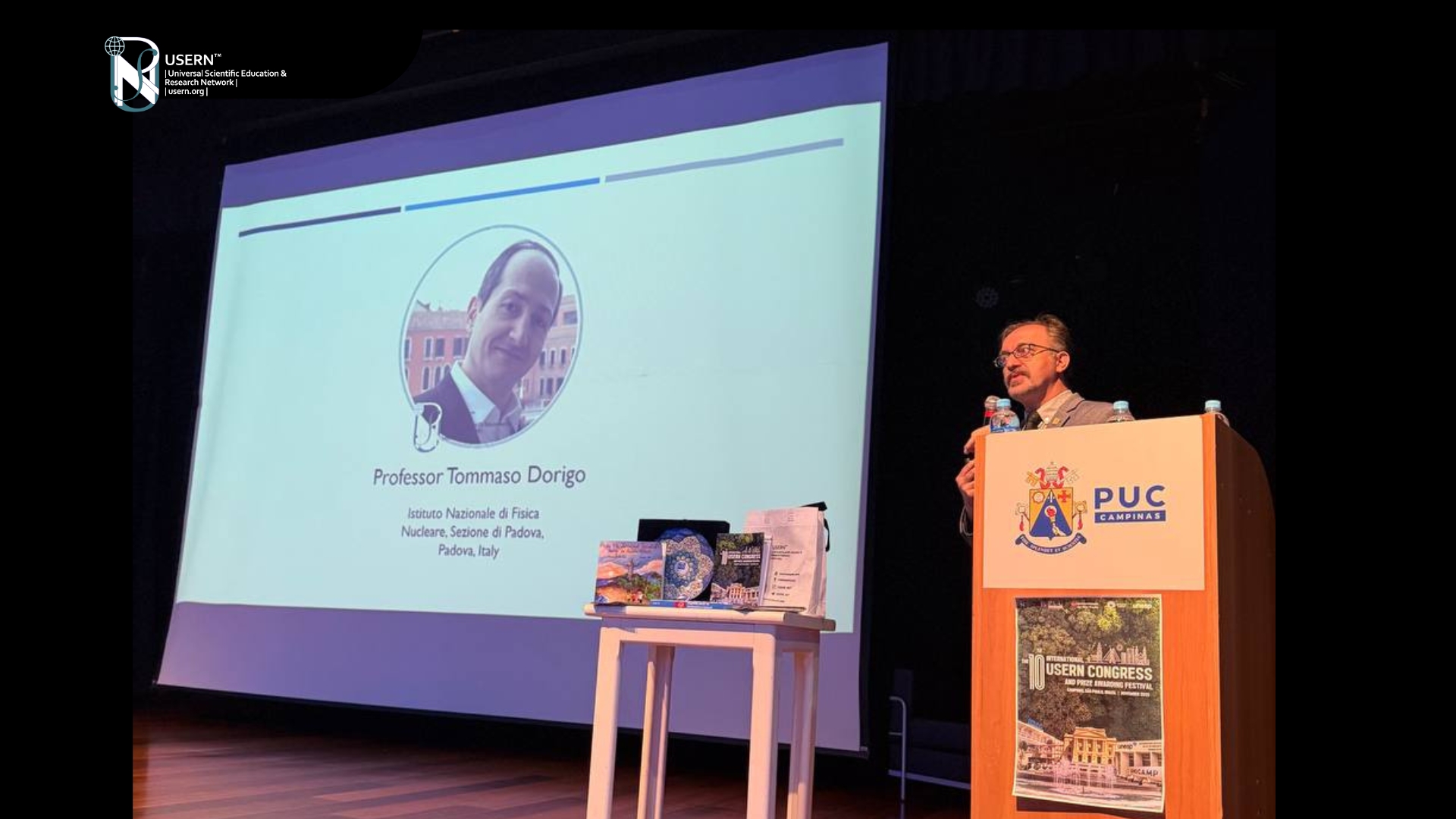
Prof. Tommaso Dorigo was re-elected as the President of USERN for the next 3 years!
The Universal Scientific Education and Research Network (USERN) is honored to announce the re-election of Professor Tommaso Dorigo as President for the 2026–2028 term. The announcement was made during the 10th International USERN Congress held in Brazil. The election was conducted according to USERN’s Statute, which states that the President serves for three years, with the possibility of two consecutive terms only, elected by majority vote of the Policy Making Council (PMC).
The first President of USERN was its founder, Professor Nima Rezaei, who served from 2016 to 2022. At the end of his second term, USERN followed its formal electoral process, through which Professor Tommaso Dorigo was elected and has served as President until the present. In 2025, 67 members of the Advisory Board from 21 scientific fields announced their candidacy for the Policy Making Council (PMC). One representative from each field was selected through popular vote, forming the newly constituted 21-member PMC.
USERN’s new Policy Making Council members are:
- Agricultural Sciences: Professor Vijay P. Singh
- Biology & Biochemistry: Professor Rafael Franco
- Chemistry: Professor Ajeet Kaushik
- Clinical Medicine: Professor Frank Sellke
- Computer Science: Professor Jan Treur
- Environment/Ecology: Professor Thomas Bosch
- Economics & Business: Professor Boqiang Lin
- Engineering: Professor Philippe Dubois
- Geosciences: Professor Hai Cheng
- Immunology: Professor Nima Rezaei
- Materials Science: Professor Manoj Gupta
- Mathematics: Professor Alessio Pomponio
- Microbiology: Professor Ute Römling
- Molecular Biology & Genetics: Professor Russel J. Reiter
- Neuroscience & Behavior: Professor George Perry
- Pharmacology: Professor Godefridus J Peters
- Physics: Professor Tommaso Dorigo
- Plant and Marine Science: Professor Tiziana Cappello
- Psychiatry/Psychology: Professor Stefan G Hofmann
- Social Sciences, General: Professor Christopher Wlezien
- Space Sciences: Professor Bahram Mobasher
Following the establishment of the new Council, six members announced their candidacy for the presidency for the 2026–2028 term.
A total of six members ran for the presidency:
-
Professor Amedeo Amedei
-
Professor Saeid Ghavami
- Professor Manoj Gupta
-
Professor Godefridus J Peters
-
Professor Frank Sellke
- Professor Tommaso Dorigo
After a vote by the newly elected PMC, Professor Tommaso Dorigo was re-elected as President for 2026–2028.
Professor Tommaso Dorigo is an experimental particle physicist recognized for his contributions to the discoveries of the top quark and the Higgs boson. He works at the Italian National Institute for Nuclear Physics (INFN), Padova, and collaborates with the CMS experiment at CERN as well as other international research initiatives. He also serves as Editor-in-Chief of Results in Physics and is an active science communicator.
Over the past three years, Professor Dorigo has played a significant role in expanding USERN’s scientific visibility, strengthening international academic collaboration, and contributing actively to USERN congresses through keynote lectures, workshops, and research publications. His long-standing support and active involvement date back to the earliest USERN congresses. Furthermore, He has published many articles in collaboration with USERN.
Looking ahead, Professor Dorigo emphasized the importance of further expanding USERN’s visibility within the global scientific community, strengthening financial sustainability through strategic sponsorships, enhancing the impact of the Annual USERN Congress, and continuing to support young scientists through improved networking and collaborative opportunities.
USERN congratulates Professor Tommaso Dorigo on his re-election and looks forward to continued progress and global collaboration under his leadership, united in the mission of advancing Science Without Borders.